How to use the calculator
Having a specific goal for your savings can help you stay motivated.Source 1 This calculator turns a goal into a plan: either the amount to set aside each time to reach it by a target date, or how long it would take at an amount you can afford.
- Savings goal: the total you want to have, such as a down payment or a trip.
- Saved so far: money you’ve already put aside for this goal. Enter 0 if you’re starting from scratch.
- What do you want to find? Choose How much to save and enter your target month and year, or How long it takes and enter the amount you can save each time.
- How often you’ll save: every week, every two weeks, twice a month or every month. Your first deposit is made this month.
- Interest (APY, optional): the annual percentage yield of the account you’re saving in. Leave it empty to leave interest out.
Copy link saves your numbers in a link you can bookmark or share, and Download CSV gives you the plan for Excel or Google Sheets.
How the calculator works
Without interest, the math is simple: the amount still to save, divided by the number of deposits you’ll make before your target month.
D equals G minus S, divided by N.
- G is your savings goal
- S is what you’ve saved so far
- N is the number of deposits: one this month, then one each week, two weeks, half month or month until your target month begins
The example the calculator opens with
A $10,000 goal three years away, with $1,000 already saved, saving every month:
- Still to save: $10,000 − $1,000 = $9,000.
- Deposits before the target month: 36, one a month starting now.
- Each deposit: $9,000 ÷ 36 = $250.
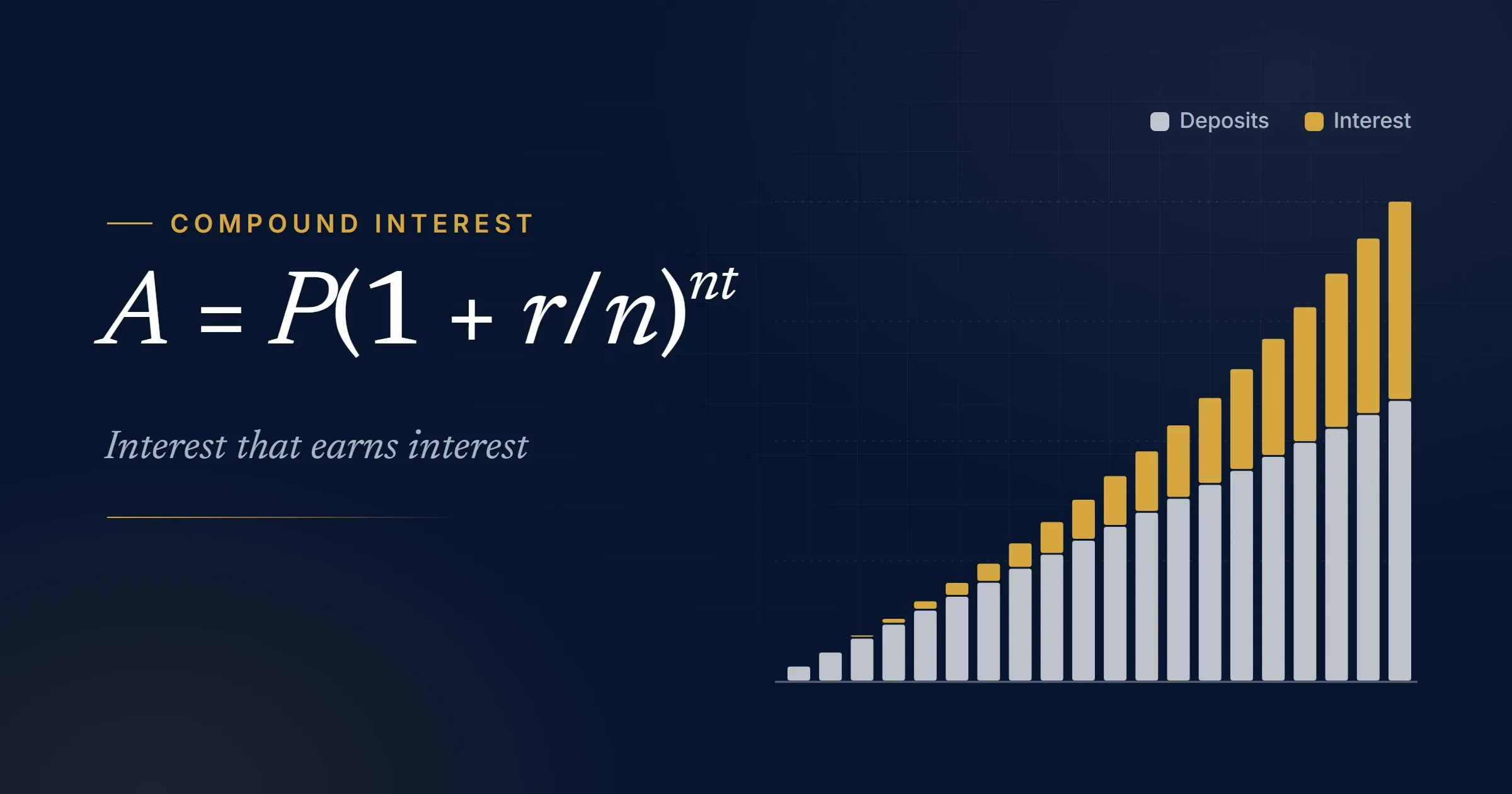
With an APY, your savings earn interest along the way, so each deposit can be a little smaller. The calculator grows what you’ve already saved, and each deposit from the day it’s made, at the APY until your target date:
D equals G minus S times the quantity 1 plus APY raised to the power T, all divided by F.
- T is the time to your target date, in years
- F is what $1 deposited on each of your deposit dates would grow to by the target date, added up: the sum of (1 + APY) t for each deposit, where t is the years from that deposit to the target date
At a 4% APY, the example needs $231.94 a month instead of $250, $18.06 less, and interest adds about $650 along the way.
The calculator rounds each deposit up to the next cent, so following the plan always reaches your goal. Saving $57.70 a week, for example, you’d finish $1.20 over. When you choose How long it takes, the calculator follows your savings month by month until they reach the goal. At $300 a month, the example goal takes about 2 years and 6 months, or 2 years and 5 months with a 4% APY.
Weekly, every two weeks, twice a month or monthly
The schedule you choose changes the size of each deposit, not how much you save overall. Here’s the same goal, $9,000 still to save over three years, on each schedule:
| How often | Each deposit | Deposits | Total deposited |
|---|---|---|---|
| Every week | $57.70 | 156 | $9,001.20 |
| Every two weeks | $115.39 | 78 | $9,000.42 |
| Twice a month | $125 | 72 | $9,000.00 |
| Every month | $250 | 36 | $9,000.00 |
No interest. Deposits are rounded up to the cent, so some schedules finish a few cents to a few dollars over.
Every two weeks means 26 deposits a year, two more than saving twice a month, so each deposit is a little smaller. If you’re paid every two weeks, matching your deposits to your paychecks keeps the plan simple.
Make the plan easier to keep
- Make it automatic. Recurring transfers move money from checking to savings without you having to remember.Source 1 Saving directly from each paycheck, such as with a direct deposit to savings, works the same way.Source 2
- Use one-time money. Tax refunds and gifts can give a goal a head start.Source 2 Add them to Saved so far and the calculator shows the smaller amount you’d need from then on.
- Keep the goal specific. A clear amount and date make it easier to see whether you’re on track.
What the results leave out
The calculator gives an estimate under simple, stated assumptions. Real results will differ.
- Rate changes. With an APY entered, the calculator keeps it the same for the whole plan. On a variable-rate account, the interest rate can change after you open it.Source 3
- Taxes on interest. Interest credited to an account you can withdraw from without penalty is generally taxable in the year it becomes available to you.Source 4
- Rising prices. If your goal is a future purchase, its price may go up by the time you buy. Consider building some extra into the goal.
- Missed deposits and exact days. The plan assumes every deposit is made on schedule and counts whole months from this month to your target month.
Common questions
How much should I save each month to reach my goal?
Subtract what you’ve already saved from your goal, then divide by the number of months until you want to reach it. For a $10,000 goal with $1,000 saved and three years to go, that’s $9,000 ÷ 36 = $250 a month. Enter your own numbers above to include interest or a different schedule.
How long will it take to reach my savings goal?
Choose How long it takes, then enter the amount you can save each time and how often. The calculator shows how many years and months it would take and the month you’d get there. Saving $300 a month toward the example goal takes about 2 years and 6 months.
Should I include interest?
Include it if the money will sit in an account that pays interest, such as a savings account, and enter that account’s APY. Leave it out for cash or an account that pays little or nothing. Because the APY can change, a plan without interest is the more cautious one.
Is what I enter saved or shared?
No. The calculator runs in your browser, and the numbers you enter aren’t sent to us. If you use Copy link, your numbers are stored in the link itself, after the # sign. Browsers don’t send that part of a link to websites, but anyone you share the link with can see the numbers. Our privacy policy has the details.
Sources
Numbers in the text link to these sources. We check them whenever we update this page.
- 1
An essential guide to building an emergency fund(external site)
Consumer Financial Protection Bureau · Updated October 29, 2025 · Accessed November 17, 2026 · Back to text for source 1
- 2
Investor Resilience – World Investor Week 2022: Investor Bulletin(external site)
Investor.gov, U.S. Securities and Exchange Commission · Published October 3, 2022 · Accessed November 17, 2026 · Back to text for source 2
- 3
12 CFR 1030.2, Definitions (Regulation DD, Truth in Savings)(external site)
Electronic Code of Federal Regulations · Accessed November 17, 2026 · Back to text for source 3
- 4
Topic no. 403, Interest received(external site)
Internal Revenue Service · Last reviewed October 7, 2026 · Accessed November 17, 2026 · Back to text for source 4
About the author
Wealthistry Editorial Team
Research, writing and editing
The team that researches, writes, fact-checks and updates Wealthistry's guides and calculators, following our published editorial standards.
Author profileEditorial policyHow we researchReport an error