How to use the calculator
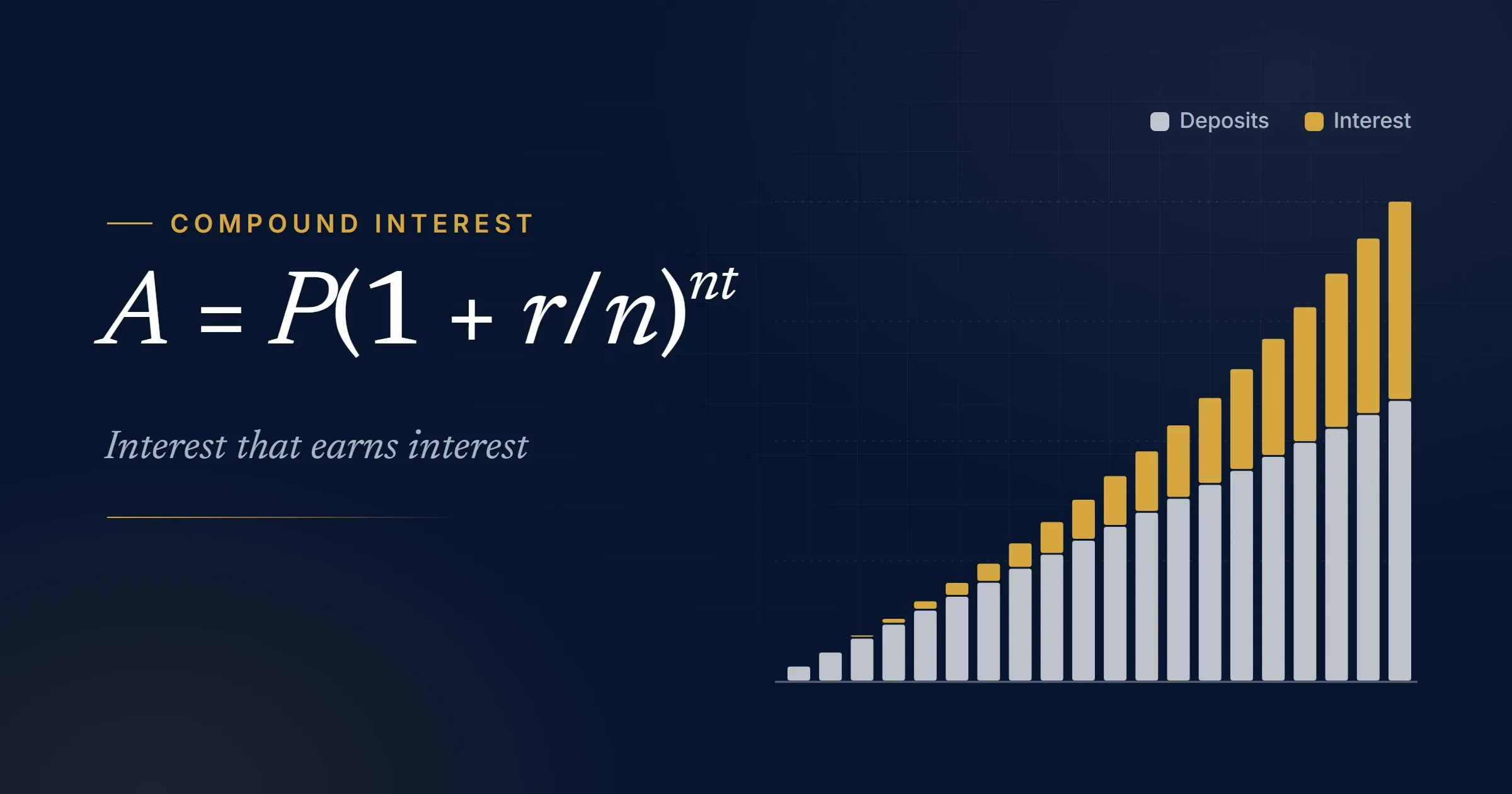
An account’s annual percentage yield (APY) is the interest it pays over a year, including the effect of compounding.Source 1 This calculator uses the APY to show how a savings account could grow, with money added or taken out each month, and updates as you type.
- Starting balance: what’s in the account now. Enter 0 if you’re opening a new one.
- Monthly deposit: what you’ll add each month. Enter 0 for none.
- Rate type and rate: the account’s APY, or its interest rate if that’s what you have. For an interest rate, also choose how often it compounds.
- Time to save: years and months, so a short goal such as 18 months works as well as a long one.
Under More options, you can switch to withdrawals, make each deposit at the start of the month instead of the end, and compare the same plan at a second APY, such as the rate your current bank pays. Copy link saves your numbers in a link you can bookmark or share, and Download CSV gives you the full table for Excel or Google Sheets.
How the calculator works
The calculator turns the APY into the monthly rate that compounds to it over 12 months, then applies that rate to your balance every month, adding or taking out your monthly amount as it goes.
i equals the quantity 1 plus APY, raised to the power one twelfth, minus 1.
- APY is the annual percentage yield as a decimal (4% is 0.04)
- i is the rate for one month. Twelve months at this rate earn exactly the APY.
B equals P times the quantity 1 plus APY raised to the power N over 12, plus D times the quantity 1 plus i raised to the power N, minus 1, all divided by i.
- P is your starting balance
- D is your monthly deposit, made at the end of each month
- N is the number of months
Deposits made at the start of each month earn one extra month of interest, which multiplies the second part by (1 + i).
The example the calculator opens with
$5,000 to start plus $200 a month, at a 4% APY, for 5 years (60 months):
- Monthly rate: (1.04)1/12 − 1 = 0.3274% a month.
- Starting balance: $5,000 × 1.045 = $5,000 × 1.216653 = $6,083.26.
- Monthly deposits: $200 × [(1 + i)60 − 1] ÷ i = $13,235.80.
- Together: $6,083.26 + $13,235.80 = $19,319.07.
You’d deposit $17,000 in total, so $2,319 of the final balance is interest. Saving for 18 months instead would give you about $9,005.
With withdrawals, the calculator follows the balance one month at a time: it adds that month’s interest, takes out your withdrawal and stops if the balance reaches zero. If your money outlasts the time you entered, it keeps going, for up to 100 years, to tell you how long the savings would last in total.
The calculator works with full precision and rounds only what it shows: whole dollars on the page and cents in the CSV download. Each row of the table is built from rounded totals, so the columns always add up.
APY vs. interest rate
A savings account’s interest rate is its yearly rate before compounding, while the APY includes compounding over a 365-day period.Source 1 The more often interest compounds, the further the APY rises above the interest rate. To turn an interest rate into an APY, use APY = (1 + r/n)n − 1, where r is the interest rate and n is how many times a year it compounds:
| Compounding | APY from a 4% interest rate |
|---|---|
| Daily | 4.08% |
| Monthly | 4.07% |
| Quarterly | 4.06% |
| Yearly | 4.00% |
Rounded to two decimal places, the way APYs are usually shown.
Choose Interest rate in the calculator and it does this conversion for you. Because the APY already includes compounding, don’t enter an APY as an interest rate with daily or monthly compounding: that would count the compounding twice.
How much the APY matters
Here’s the opening example, $5,000 plus $200 a month for 5 years, at a range of APYs:
| APY | Balance after 5 years | Interest earned |
|---|---|---|
| 0.5% | $17,275 | $275 |
| 1% | $17,553 | $553 |
| 2% | $18,124 | $1,124 |
| 3% | $18,713 | $1,713 |
| 4% | $19,319 | $2,319 |
| 5% | $19,944 | $2,944 |
Deposits at the end of each month. Rounded to the nearest dollar.
The same deposits earn $275 at a 0.5% APY and $2,944 at 5%, a difference of $2,669 over five years. For comparison, the FDIC’s national average rate for savings accounts, which weights each bank’s rate by its deposits, was 0.39% in November 2026.Source 2 To check what moving your savings would be worth, enter the new account’s APY as the rate and your current account’s APY under Compare with another APY.
What the results leave out
The calculator gives an estimate under simple, stated assumptions. Real results will differ.
- Rate changes. The calculator keeps the APY the same for the whole time. On a variable-rate account, the interest rate can change after you open it.Source 1
- Taxes. Interest credited to an account you can withdraw from without penalty is generally taxable in the year it becomes available to you.Source 3 The calculator doesn’t subtract any tax.
- Fees. A monthly maintenance fee or other account fees would reduce your balance.
- Exact days. Banks work out interest on your balance for each day,Source 4 and months have different lengths. The calculator treats every month as one-twelfth of a year, which keeps each year’s growth equal to the APY.
Common questions
How long will my savings last if I make withdrawals?
Open More options, choose Withdrawals and enter your balance, the monthly amount you’ll take out and the APY. If the money runs out within the time you entered, the headline shows how long it lasts; if not, the results show what’s left and how long it would last in total. Withdrawing $400 a month from $50,000 at a 4% APY, you’d still have about $34,361 after five years, and the money would last about 13 years and 6 months in total. Withdraw $150 a month instead and the interest, about $163.69 in the first month, covers each withdrawal, so the balance keeps growing.
What’s the difference between APY and APR?
They answer different questions. APR is mostly used for borrowing: it’s the yearly cost of credit, such as a loan or a credit card.Source 5 For savings, the APY is the number to compare, because it includes compounding. Some banks also call a savings account’s interest rate its “annual percentage rate”; it’s the rate before compounding,Source 1 so it’s lower than the APY.
Can I use this calculator for a CD?
Yes. Enter the amount you’ll put in as the starting balance, the CD’s APY as the rate and its term as the time, and set the monthly deposit to 0 if the CD doesn’t accept added deposits. Check the CD’s terms for what happens if you withdraw early, since penalties aren’t included here.
Why is my bank’s interest a little different?
Banks calculate interest for each day and choose how often to compound and credit it,Source 4 and a variable rate can change. The calculator assumes the APY stays the same and treats each month as an equal share of the year, so small differences are normal.
Is my money in a savings account insured?
At an FDIC-insured bank, deposits are insured up to at least $250,000 per depositor, per ownership category.Source 6 At a federally insured credit union, the NCUA insures individual accounts up to $250,000.Source 7 Check that your bank or credit union is insured before you open an account.
Is what I enter saved or shared?
No. The calculator runs in your browser, and the numbers you enter aren’t sent to us. If you use Copy link, your numbers are stored in the link itself, after the # sign. Browsers don’t send that part of a link to websites, but anyone you share the link with can see the numbers. Our privacy policy has the details.
Sources
Numbers in the text link to these sources. We check them whenever we update this page.
- 1
12 CFR 1030.2, Definitions (Regulation DD, Truth in Savings)(external site)
Electronic Code of Federal Regulations · Accessed November 17, 2026 · Back to text for source 1
- 2
National Rates and Rate Caps – November 2026(external site)
Federal Deposit Insurance Corporation · Updated November 16, 2026 · Accessed November 17, 2026 · Back to text for source 2
- 3
Topic no. 403, Interest received(external site)
Internal Revenue Service · Last reviewed October 7, 2026 · Accessed November 17, 2026 · Back to text for source 3
- 4
12 CFR 1030.7, Payment of interest (Regulation DD, Truth in Savings)(external site)
Electronic Code of Federal Regulations · Accessed November 17, 2026 · Back to text for source 4
- 5
Electronic Code of Federal Regulations · Accessed November 17, 2026 · Back to text for source 5
- 6
Understanding Deposit Insurance(external site)
Federal Deposit Insurance Corporation · Updated April 1, 2024 · Accessed November 17, 2026 · Back to text for source 6
- 7
Share Insurance Coverage(external site)
National Credit Union Administration · Updated May 20, 2025 · Accessed November 17, 2026 · Back to text for source 7
About the author
Wealthistry Editorial Team
Research, writing and editing
The team that researches, writes, fact-checks and updates Wealthistry's guides and calculators, following our published editorial standards.
Author profileEditorial policyHow we researchReport an error