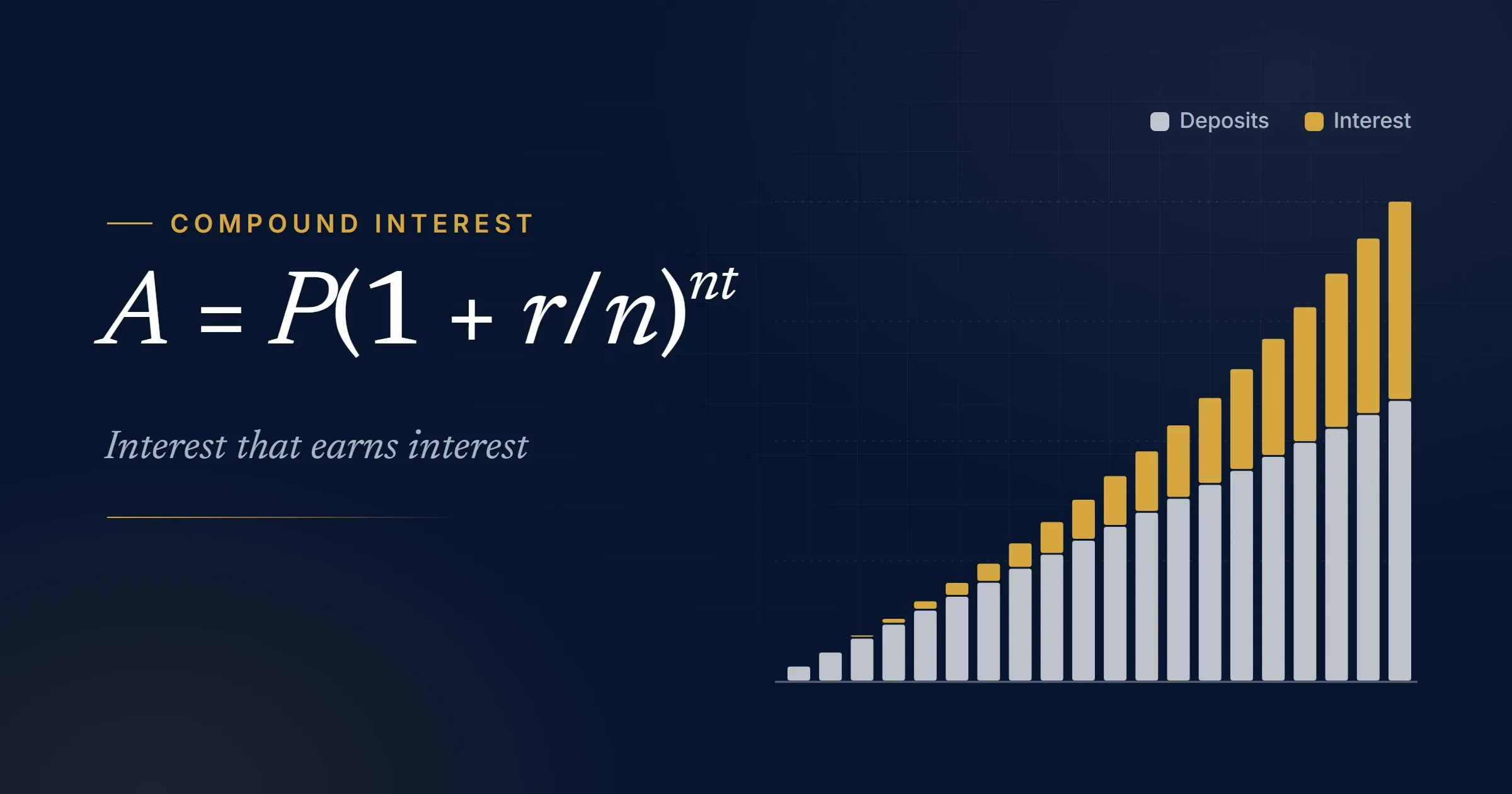
Financial Literacy
Compound Interest Explained: How It Works, With Examples
How compound interest works, step by step: the formula, worked examples, monthly deposits, the Rule of 72, and what it means for your savings and debt.
9 min read

Personal finance for everyday decisions
Practical guides and free calculators for budgeting, saving, debt and banking. Every page shows its sources, assumptions and formulas, so you can check the numbers yourself.
Official sources we cite
Worked example
Compound growth
$82,207
Saving $200 a month for 20 years at 5% a year
The formula
Future value equals P times the quantity 1 plus r, to the power n, minus 1, all divided by r.
P = $200 a month · r = 5% ÷ 12 · n = 240 months
Featured guide
Researched from primary sources, with every number worked out in the open.
Financial Literacy
How compound interest works, step by step: the formula, worked examples, monthly deposits, the Rule of 72, and what it means for your savings and debt.
9 min read
Explore by topic
Six focused areas, each built around the decisions people actually make.
Build a monthly plan that fits your real take-home pay, from the 50/30/20 rule to zero-based budgets.
Set savings goals, build an emergency fund and decide where to keep it.
Understand interest and minimum payments, and compare payoff methods with real numbers.
Checking vs. savings, APY and FDIC insurance, explained in plain English.
Core ideas like compound interest and inflation, with worked examples you can follow.
Free tools that show their formulas, assumptions and results. No sign-up required.
Free calculators
Each calculator explains its formula, assumptions and rounding, and runs in your browser.
See where your take-home pay goes each month.
Find a savings target based on your essential expenses.
Work out how much to save, and by when.
Compare snowball and avalanche plans side by side.
See how money can grow over time, year by year.
Estimate your payoff date and the total interest you'd pay.
Project savings growth using an account's APY.
Our standards
Money guidance should be easy to verify. Here is what you can expect on every page.
We link to primary sources such as the CFPB, FDIC and Federal Reserve, and show when information was last reviewed.
How we researchGuides and calculators show their formulas, assumptions and rounding, so nothing is a black box.
See the calculatorsEditorial decisions stay separate from any commercial relationship, and corrections are made openly.
Read our editorial policy