How to use the calculator
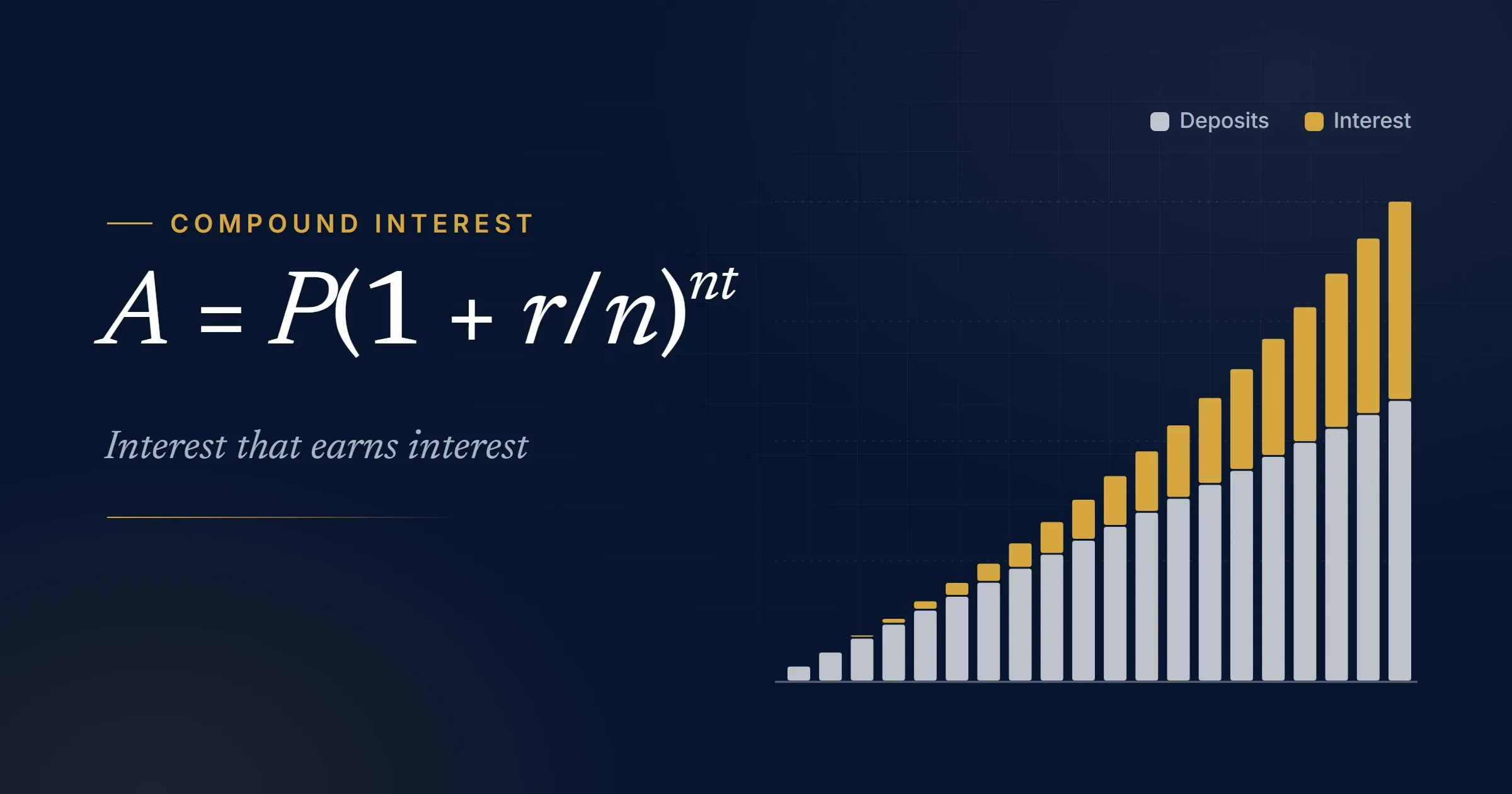
Compound interest is interest earned on your original money and on the interest it has already earned.Source 1 This calculator shows how that adds up for a starting amount plus regular deposits, and updates as you type.
- Initial deposit: the money you start with. Enter 0 if you’re starting from nothing.
- Regular deposit: what you add each month or each year. Enter 0 for none.
- Annual interest rate: the yearly rate before compounding. If you know only an account’s APY, see the first question below.
- Years to grow: any whole number of years from 1 to 100.
- Compounding: how often interest is added to your balance, from daily to yearly.
Under More options, you can switch to withdrawals, make each deposit at the start of its month or year instead of the end, and enter an inflation rate to see the final balance in today’s dollars. Copy link saves your numbers in a link you can bookmark or share, and Download CSV gives you the year-by-year table for Excel or Google Sheets.
How the calculator works
The calculator grows your starting amount and your deposits separately, then adds the two together.
A equals P times the quantity 1 plus r over n, raised to the power n times t.
- P is your initial deposit
- r is the annual interest rate as a decimal (5% is 0.05)
- n is how many times a year interest compounds
- t is the number of years
FV equals PMT times the quantity 1 plus i, raised to the power N, minus 1, all divided by i.
- PMT is the amount you deposit each month or year
- N is the number of deposits
- i is the interest rate for each deposit period
When you deposit as often as interest compounds, i is simply r/n. When the schedules differ, the calculator uses the rate per deposit period that gives the same growth over a year: i = (1 + r/n)n/p − 1, where p is the number of deposits a year. Deposits made at the start of each period earn one extra period of interest, which multiplies the result by (1 + i).
The example the calculator opens with
$10,000 to start plus $200 a month, at 5% compounded monthly, for 20 years:
- Starting amount: $10,000 × (1 + 0.05 ÷ 12)240 = $10,000 × 2.712640 = $27,126.40, using the growth factor rounded to six decimal places.
- Monthly deposits: $200 × [(1 + 0.05 ÷ 12)240 − 1] ÷ (0.05 ÷ 12) = $82,206.73.
- Together: $27,126.40 + $82,206.73 = $109,333.14.
You’d put in $58,000, so $51,333 of the final balance is interest. With simple interest, which never earns interest on interest, the same deposits would grow to $91,900. Compounding adds $17,433.
With withdrawals, the calculator follows the balance one period at a time: it adds that period’s interest, takes out your withdrawal and stops if the balance reaches zero. Withdrawing $1,000 a month from $100,000 that earns 4% compounded monthly, the money would last about 10 years and 2 months.
For today’s dollars, the calculator divides the final balance by (1 + the inflation rate) raised to the number of years. Inflation is the increase in the prices of goods and services over time,Source 2 so each future dollar buys less. At 3% inflation a year, the example’s $109,333 would buy about what $60,535 buys today.
The calculator works with full precision and rounds only what it shows: whole dollars on the page and cents in the CSV download. Each row of the year-by-year table is built from rounded totals, so the columns always add up.
How compounding and timing change the result
The more often interest compounds, the more you earn, but the differences are small next to the rate you earn and the time you leave the money to grow. Here’s the opening example with each compounding option:
| Compounding | Balance after 20 years | Interest earned |
|---|---|---|
| Daily | $109,484 | $51,484 |
| Monthly | $109,333 | $51,333 |
| Quarterly | $109,025 | $51,025 |
| Twice a year | $108,572 | $50,572 |
| Yearly | $107,694 | $49,694 |
Deposits at the end of each month. Rounded to the nearest dollar.
Daily compounding comes out $1,790 ahead of yearly compounding over 20 years. Timing matters a little too: making each deposit at the start of the month instead of the end gives $109,676, or $343 more.
What the results leave out
The calculator gives an estimate under simple, stated assumptions. Real results will differ.
- Changing rates and returns. The calculator uses the same rate every year. Savings rates can change, and investments don’t earn a fixed rate: all investments involve some degree of risk.Source 3
- Taxes. Most interest credited to an account you can withdraw from without penalty is taxable in the year it becomes available to you.Source 4 The calculator doesn’t subtract any tax.
- Fees and penalties. Account fees, fund fees and penalties, such as for withdrawing early from a CD, would reduce your balance.
- Inflation, unless you enter a rate. Inflation reduces purchasing power, which is a risk for anyone earning a fixed rate of interest.Source 3
Common questions
Should I enter the APY or the interest rate?
Either works, as long as you pair it with the right compounding. An account’s annual percentage yield (APY) already includes the effect of compounding over a year.Source 5 So if you know only the APY, enter it as the rate and choose Yearly compounding. Choosing monthly compounding would count the compounding twice: $10,000 for 10 years at a 4.5% APY would show $15,669.93 instead of $15,529.69, overstating the result by $140.24.
How do I calculate compound interest with monthly contributions?
Grow the starting amount with the first formula, grow the deposits with the second, then add the two, as in the worked example above. Our guide Compound Interest Explained walks through both formulas step by step, with the matching Excel and Google Sheets functions.
How long will my money last if I take withdrawals?
Open More options, choose Withdrawals, then enter your starting amount and what you’ll take out each month or year. The calculator shows how long the money would last, or what would be left after the years you entered. In the example above, the money lasts about 10 years and 2 months, and you’d take out $121,842 in total, including $21,842 of interest earned along the way.
What inflation rate should I use?
There’s no single right number, so try a few. For reference, the Federal Reserve aims for inflation of 2% a year over the longer run, measured by the price index for personal consumption expenditures.Source 2 Actual inflation can be higher or lower in any year. At 2%, the example’s balance would be worth about $73,578 in today’s dollars; at 3%, about $60,535.
Is what I enter saved or shared?
No. The calculator runs in your browser, and the numbers you enter aren’t sent to us. If you use Copy link, your numbers are stored in the link itself, after the # sign. Browsers don’t send that part of a link to websites, but anyone you share the link with can see the numbers. Our privacy policy has the details.
Sources
Numbers in the text link to these sources. We check them whenever we update this page.
- 1
Compound Interest(external site)
Investor.gov, U.S. Securities and Exchange Commission · Accessed November 17, 2026 · Back to text for source 1
- 2
Board of Governors of the Federal Reserve System · Updated August 22, 2025 · Accessed November 17, 2026 · Back to text for source 2
- 3
Investor.gov, U.S. Securities and Exchange Commission · Accessed November 17, 2026 · Back to text for source 3
- 4
Topic no. 403, Interest received(external site)
Internal Revenue Service · Last reviewed October 7, 2026 · Accessed November 17, 2026 · Back to text for source 4
- 5
12 CFR 1030.2, Definitions (Regulation DD, Truth in Savings)(external site)
Electronic Code of Federal Regulations · Accessed November 17, 2026 · Back to text for source 5
About the author
Wealthistry Editorial Team
Research, writing and editing
The team that researches, writes, fact-checks and updates Wealthistry's guides and calculators, following our published editorial standards.
Author profileEditorial policyHow we researchReport an error